
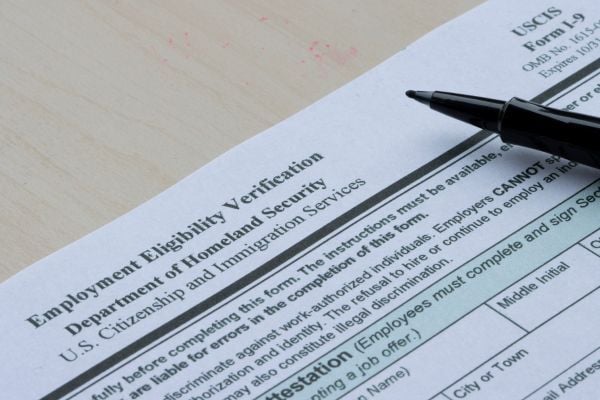
The U.S. Immigration and Customs Enforcement (ICE) recently updated its enforcement approach, including reclassifying violations and increasing penalties for several commonly made Form I-9 errors. This marks a major shift from long-standing guidance that has been in place for nearly 30 years.
Form I-9 errors are grouped into two categories:
- Technical or procedural failures are minor errors that employers can correct within a 10-day window after an inspection (e.g., failing to use the current Form I-9 version).
- Substantive paperwork violations are more serious failures that could result in immediate monetary penalties for employers. The updated guidance expands the list of violations considered “substantive,” including:
-
- missing employee information (e.g., date of birth, required identifiers),
- missing signatures or dates in key sections,
- improper completion of Section 1 or Section 2, and
- certain errors related to electronic I-9 systems or remote verification procedures.
More than 10 error categories previously treated as correctable technical violations, eligible for the statutory 10-day cure period, are now reclassified as substantive violations subject to immediate fines of $288 to $2,861 per form. Because penalties are assessed per form, even a modest error rate can result in substantial exposure. For example, 50 deficient forms could result in tens of thousands of dollars in fines.
Given the increased risk, employers should take proactive steps to strengthen Form I-9 compliance.
- Conduct a proactive I-9 audit
Review existing forms for completeness and accuracy, especially errors that may now be classified as substantive. - Retrain staff responsible for I-9 completion
Ensure HR teams and hiring managers understand the importance of accuracy and timeliness. - Evaluate electronic Form I-9 systems
Confirm systems meet federal requirements for audit trails, signatures and data integrity. - Review remote verification practices
If using alternative procedures, ensure full compliance with Department of Homeland Security (DHS) requirements. - Document good-faith compliance efforts
ICE considers employer good faith when assessing penalties, so maintaining documentation of audits and corrective actions is critical.
Employers are advised to act soon to review internal Form I-9 processes to reduce future audit risk. For more information, contact HRConsulting@bukaty.com.


